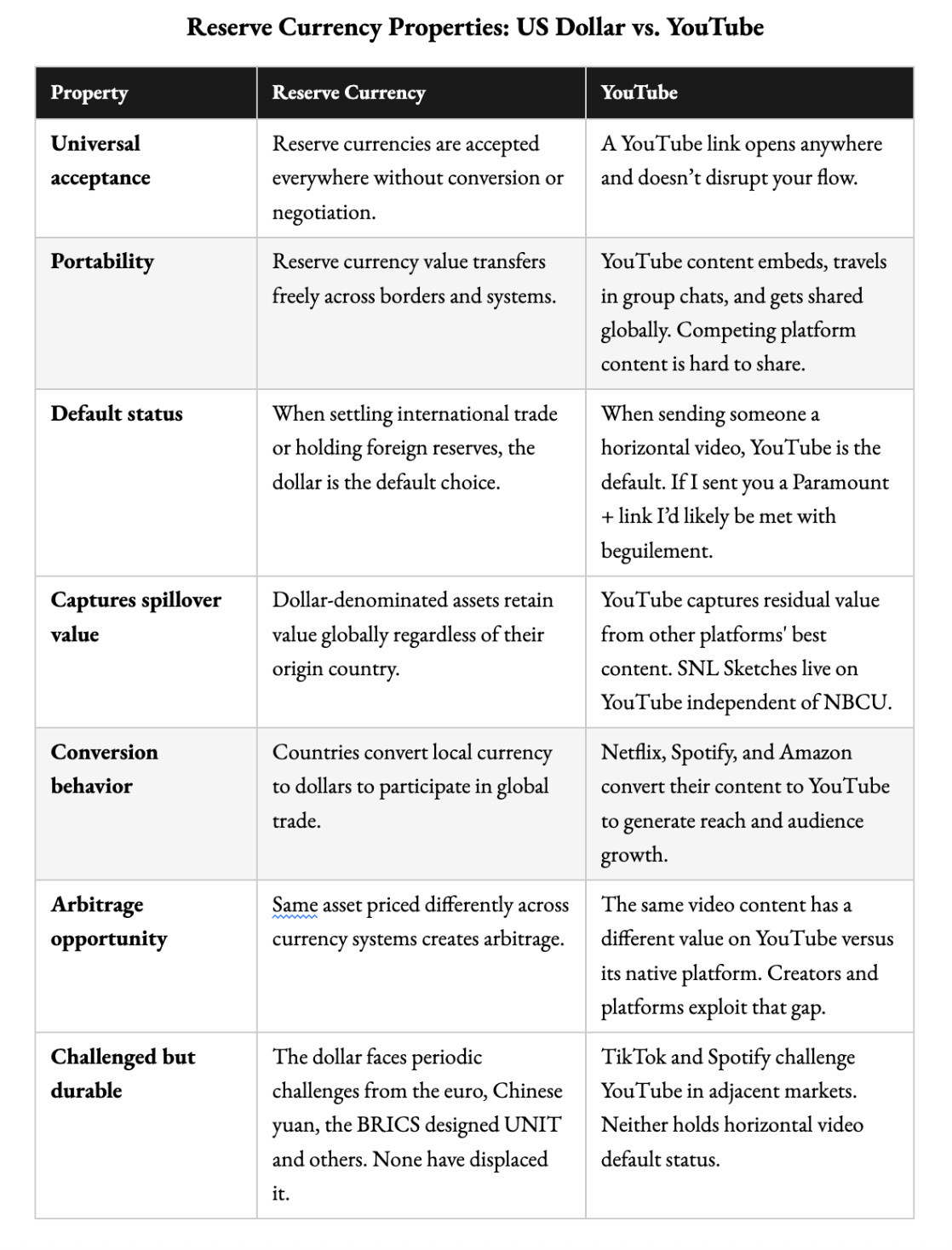
Is YouTube the Reserve Currency of Horizontal Video?

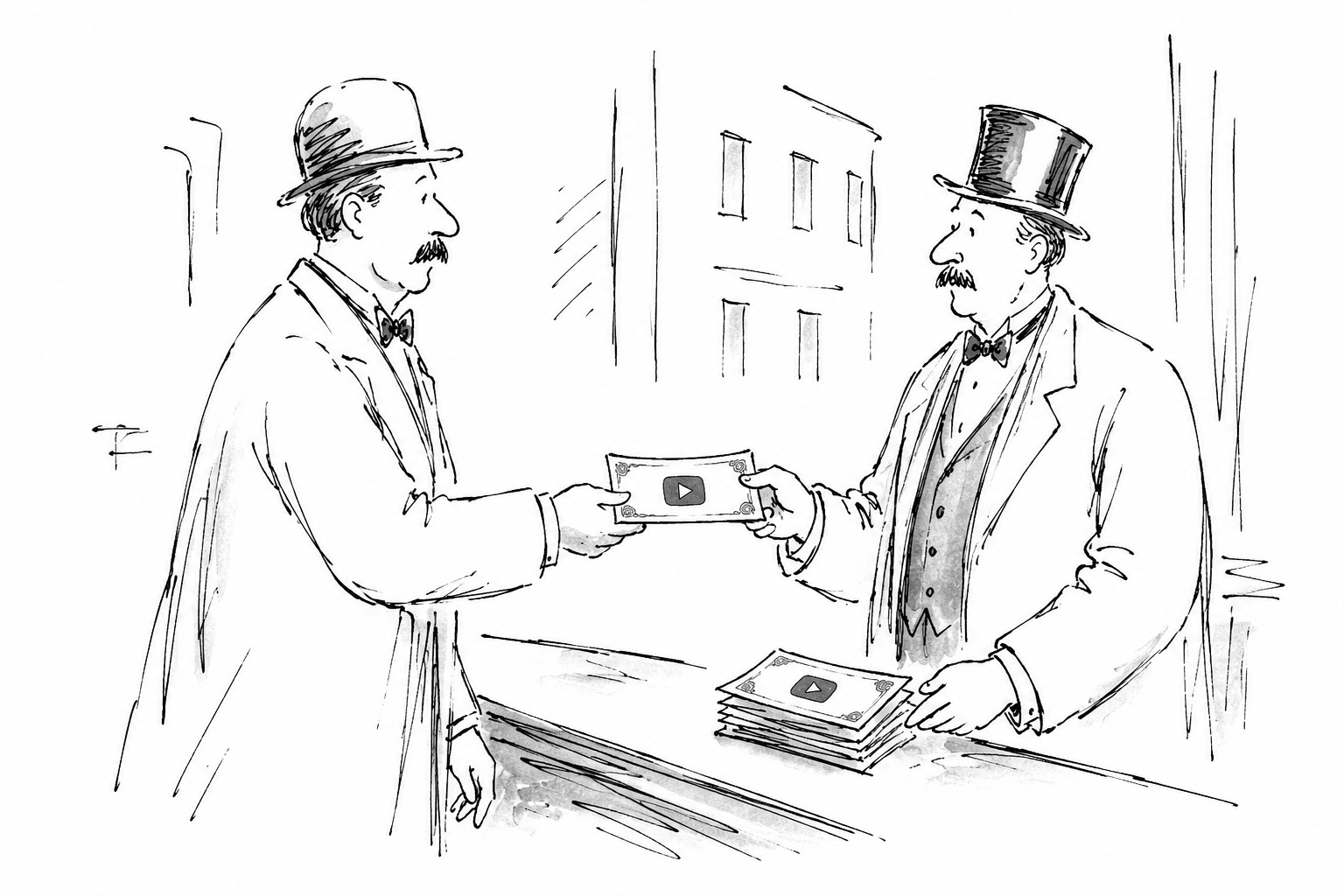
If you think of a moment, clip, or video you want to share with someone, what is the first place you think of to find it?
YouTube, Right?
There have been many conversations about the ubiquity of YouTube and what it means for media. Many have suggested metaphors to contextualize its rise and stranglehold on horizontal video and media, but there might be one in an unexpected place, currency markets.
In 1944, representatives from 44 countries met at a hotel in Bretton Woods, New Hampshire (Good for New Hampshire!) and agreed the U.S. dollar would serve as the world’s “reserve currency”. Trade would be denominated in it, and other currencies would be pegged to it. The world needed a common unit of exchange, and they picked the one that was the strongest and viewed as the most stable. It was meant to bring stability to a world and global economy shaken by two world wars. It meant that when you thought about money, you thought about the U.S. dollar.
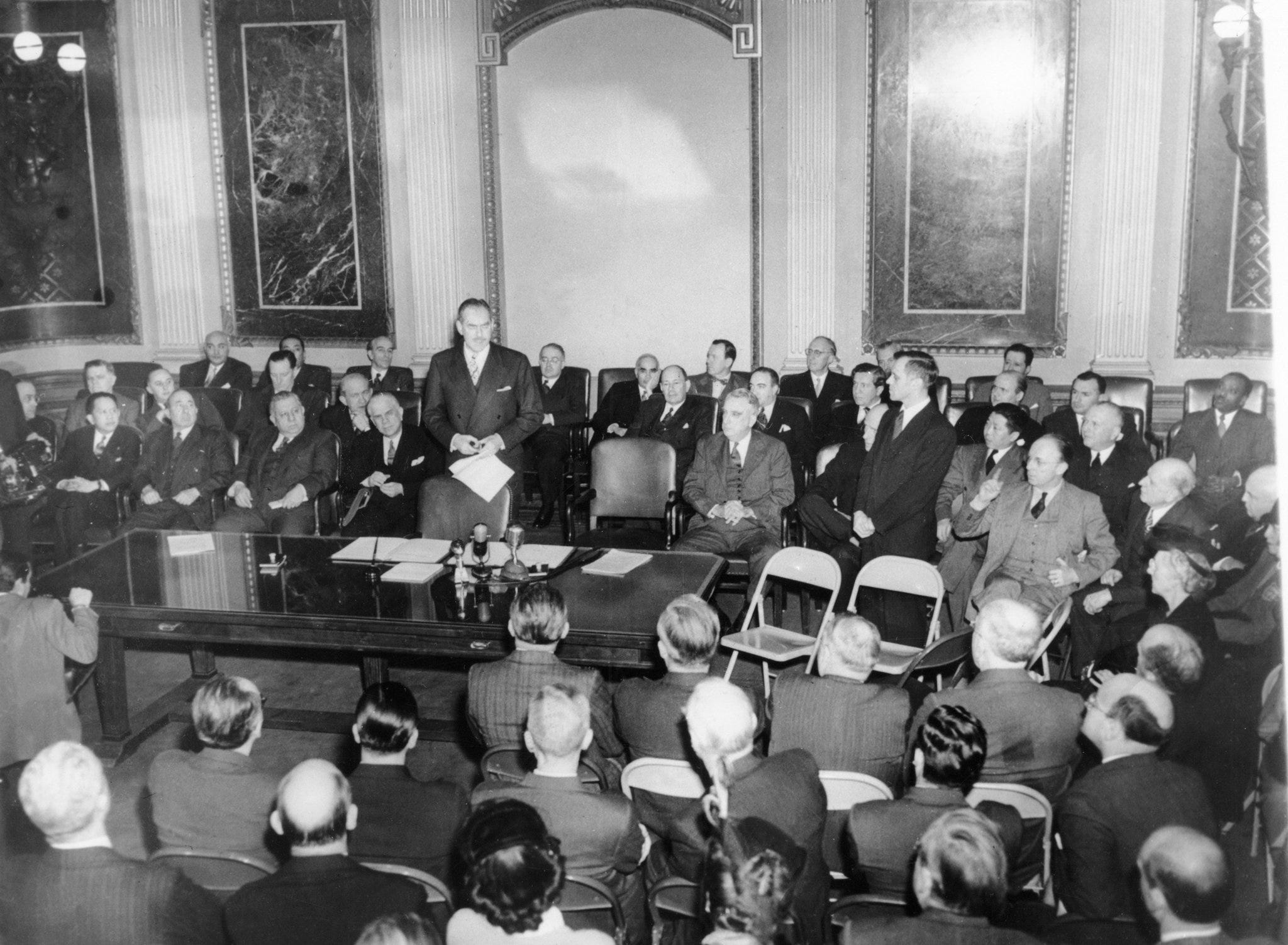
Source: The New York Times
No meeting in New Hampshire happened for horizontal video (Sorry, New Hampshire). But sometime in the past decade, YouTube became the reserve currency of horizontal video, and the rest of the industry is fully reckoning with what that means and how it has allowed YouTube to dominate horizontal video viewing time and mindshare. When you think about video, you think about YouTube.
The simplest argument is behavioral and anecdotal. When you want to send someone a horizontal video, you send a YouTube link. When you look for highlights, you go to YouTube. When you want to see a specific SNL sketch, you usually go to YouTube instead of Peacock. Content from streamers doesn’t travel very well and isn’t optimized for sharing. The currency of Netflix has sharing friction, that’s why people mostly use Netflix currency on Netflix. A YouTube link opens quickly and doesn’t tax the brain, requires no subscription, no login, no app, no conversion. It just shows up. That portability is a defining property of a reserve currency, accepted everywhere and reliable.
Every other horizontal video platform operates as a mostly closed monetary system. Their content has real value, sometimes extraordinary value, but that value is trapped inside the platform. A great episode from a prestige HBO drama exists on HBO Max. You can describe it to someone, but it is isn’t easy to share or easy to pull up on your phone quickly. The content feels illiquid outside its native environment. A dollar-denominated asset in a country that doesn’t accept dollars. This is all well and good if you fill the system with users, but in a world where any sort of friction is unbearable to consumers and YouTube is free, it poses an existential problem for premium providers hoping for people to use their currency.
YouTube content moves easily. It embeds in articles, lives in group chats, gets texted between people and is easy to show to your friend (nothing more nerve wracking than sharing what you think is a funny video and praying for a laugh). The late night industry is the clearest case. NBC, CBS, and ABC now upload nearly every segment, every monologue, every celebrity interview to YouTube within hours of broadcast. A clip from The Tonight Show or Late Show regularly pulls more views on YouTube than the original television broadcast did. The networks built content specifically for a platform they don’t own because that is where the reserve currency lives. The show airs on NBC while the moment lives in people’s minds on YouTube.
The Google acquisition in 2006 was an accidental Bretton Woods moment. Google paid $1.65 billion for a platform that was, at the time, a copyright lawsuit vacuum, sucking up time from the legal teams of media conglomerates. Viacom sued for $1 billion within months. The major media companies saw YouTube as a piracy operation undercutting their closed currencies. They were right about what it was doing but wrong about thinking they could nip it in the bud. Rather than building a coordinated alternative, they used litigation to try and stop inevitable technological progress. By the time the industry understood what had happened, YouTube had the network effects, the creator ecosystem, and the search infrastructure that made displacement very difficult. Bretton Woods worked because the dollar was already the dominant trade currency before anyone formalized it. Google’s acquisition formalized something similar, and the opposition spent the next decade in court trying to protect the margin rich cable and network ecosystem while consumers wanted a new video currency.
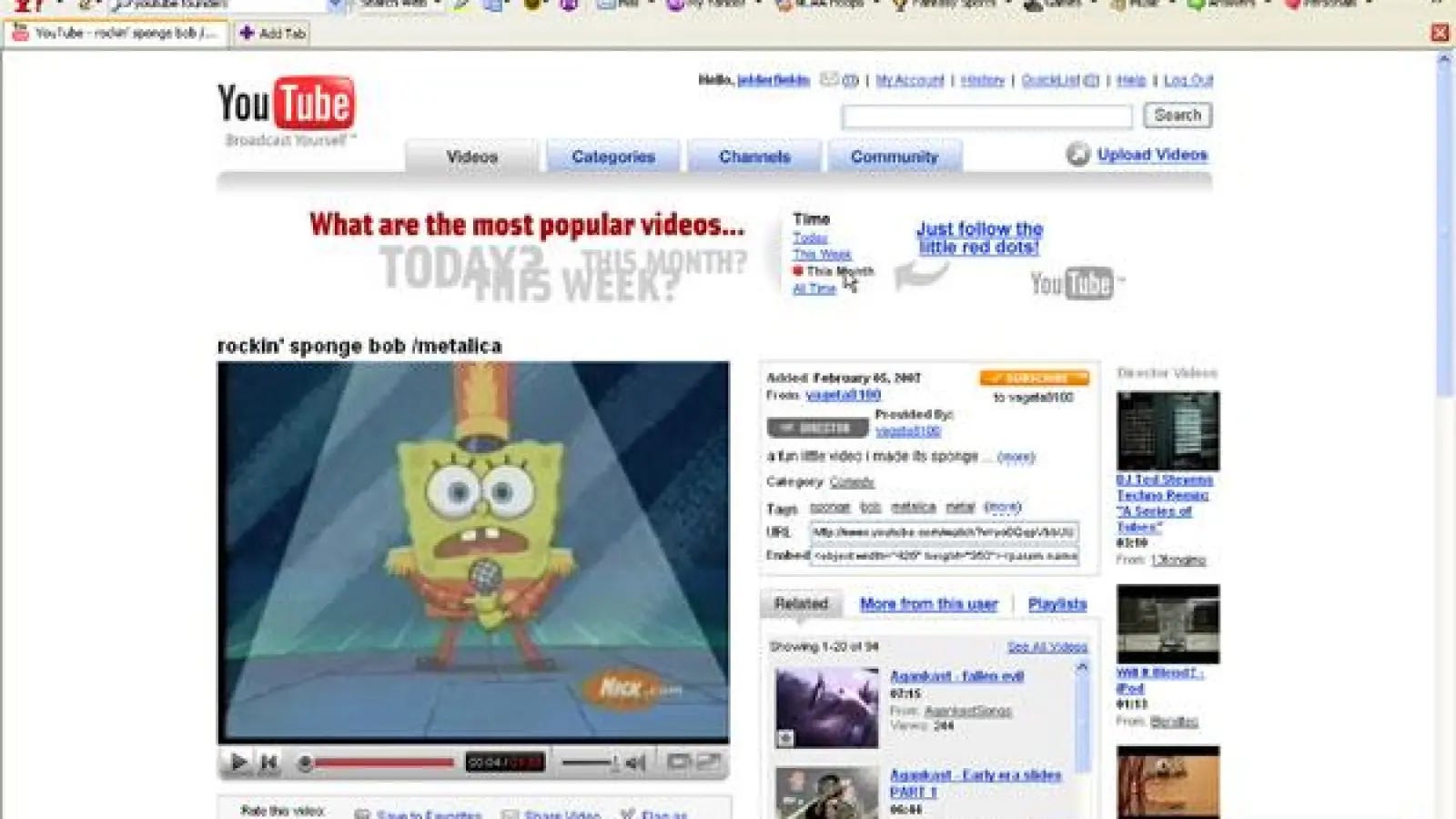
Source: The Denver Post
The more interesting development now is conversion. Platforms have started treating YouTube as a reserve system even when they won’t say so explicitly. Netflix puts full episodes on YouTube to drive subscriber acquisition, converting their closed currency into the open one to generate demand, then hoping viewers return to their system to watch the rest. A podcast that lives on Spotify finds its growth inflections when clips surface on YouTube. Amazon made a deal with MrBeast for a Prime Video show, and his YouTube channel generated more cultural conversation about the content than the platform it technically lived on.
This is a horizontal video currency arbitrage. The same horizontal video content has a different exchange rate depending on which system it runs through. When a show underperforms on its native platform and overperforms on YouTube, the content finds the market where its currency is worth more. Platforms uploading content to YouTube, building YouTube presences, chasing the YouTube audience, each of those decisions is an acknowledgment that the exchange rate favors YouTube and that their own currency needs conversion to generate real reach.
The social layer matters too. YouTube has had a functioning community economy for twenty years. Comments, response videos, reaction channels, whole careers built on engaging with other channels. Netflix has made attempts at community features but the infrastructure was never built for exchange, and you can feel it when you use it.
Reserve currencies attract challengers because the dominant position gives whoever holds it leverage over the entire system. The dollar’s status gives the United States economic leverage other countries find uncomfortable, which is why there are periodic serious attempts at alternatives. YouTube’s position gives Google something equivalent in horizontal video. TikTok is the most credible challenger in video broadly but operates in vertical format, which is a different market with a different viewer relationship. Spotify is pushing into video podcasting. Neither has the horizontal default status, the search infrastructure, or twenty years of embedded creator relationships to dethrone YouTube.
Reserve currencies don’t last forever. The pound sterling held reserve status before the dollar and before that it was the Dutch Guilder and so on. YouTube’s position runs on Google’s infrastructure, which could come under regulatory scrutiny across multiple continents. The creator economy that underpins much of the platform could migrate toward a better-monetizing alternative if creators and IP holders feel that Google starts to bogart too much of the value being created.
But displacement requires coordination that nobody has managed yet and will be virtually impossible given the tens of millions of entities posting to YouTube daily. You can’t replace a reserve currency unilaterally. You need enough of the world to agree on something else, and the last time anyone tried to coordinate against YouTube they filed a lawsuit, lost, and watched it become the default horizontal video platform on the internet.